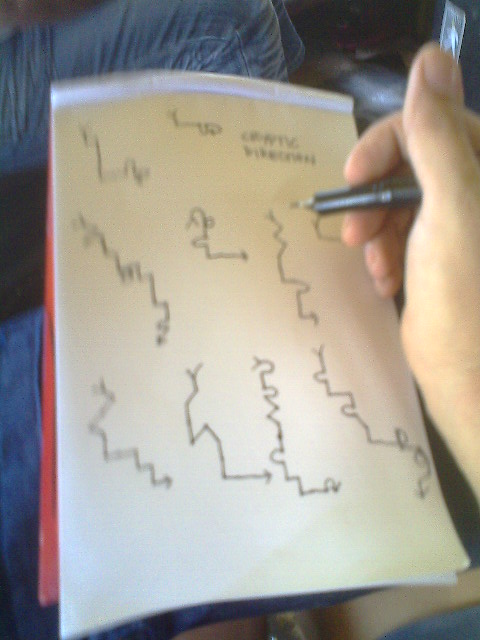
It's been exactly two years since I last posted! That's a record! Bad, though. :( I just found out that it's exactly two years just before typing the first words of this blog post. Earlier today, though, as I was on a ride to some place, I took the time to think about this blog, what I should add, how often should I add to it, etc. It should be more often than once in two years, I know! :D
Good thing I had my pen with me and some index cards in my pocket so I got to jot down some ideas, actually. It used to be that I ALWAYS had a pen and paper... then I always had something to take note of. When oblivion sets in, whatever I think about while having no pen is just something that might just come back later.
While traveling, I was trying to develop some new codes. While thinking, my mind detoured to the idea of what actually makes a good code. This is my personal opinion. For me, what makes a good code is not being able to actually think that it IS ACTUALLY a code. So when a coded message on a piece of paper crosses from one eye to another, those unconcerned will never suspect that it is a coded message that they would even take interest to decipher.
Human beings have the natural tendency to find out more, especially when there is some mystery attached. If there is a coded message on a piece of paper lying down on the table, the onlooker will tend to look and even think further and deeper! If it doesn't look like a code, then it just lays there not getting any attention at all... unless the intended recipient gets hold of it.
Another aspect of what makes a good code is, according to my personal opinion, it should be decipherable without having to get a pen and paper. It should be pure mental wit and skill. That way, the person reading will just be seen as a person reading what is obvious.
The third aspect is, the writer must be able to write the code mentally too.
Maybe that's why it takes some time for me to develop new codes... I don't want to depend on memory as we know that as we grow older, the better we forget! :D As long as it's decipherable (using mere common sense and intelligence) then oblivion is not much of a problem.
In conclusion, what makes a code good (in my opinion)?
1. It must not look like a code.
2. It must be decipherable mentally.
3. It must be coded mentally.